Infoverity helps companies build the data platforms, analytics layers, and intelligence pipelines that close the gap between the data enterprises hold and the decisions they need to make. The same infrastructure is what makes AI reliable when you are ready to run it.













Most enterprises run on data they do not fully trust. Reports take days to produce and still contradict each other. Business users queue up requests to a technical team that spends more time extracting than answering. The same metric has three definitions depending on which system you pulled from. This is not a tooling problem. It is a platform and architecture problem, and it compounds the moment AI enters the picture. Generative models and AI agents are only as reliable as the data they use to reason. Siloed systems and inconsistent definitions do not just slow analytics. They make AI outputs ungovernable.
Infoverity’s Analytics, AI and Modern Data practice closes this gap: we design and build the cloud data warehouses, semantic layers, and KPI frameworks that give every team access to data they can actually trust, then deploy the AI models that sit on top of it. More than 1,000 projects delivered. Over 200 enterprise clients. The platform work and the AI work are one program, not two.
Infoverity’s expertise has greatly changed the landscape of data at SSM.
"We have not only mastered 4 domains in less than 18 months, but we have also been able to create a strategic data roadmap for the next 2 years. The team has helped us build a best-in-class MDM and Data Governance platform, while continuing to accelerate our development of an integrated, self-service data ecosystem for SSM to utilize. We would not be where we are in our data journey without Infoverity as a strategic thought and implementation partner."
We consolidate data from across your warehouses, lakes, and operational systems, define the business logic that makes every metric consistent, and build the platform that gives every team a version of the data they can trust. Not just a data store. An intelligence layer.
We implement the semantic layer, data catalogue, and access controls that let analysts, operations teams, and business users find, understand, and use data independently. One organization we worked with went from routing every data request through a single technical team to self-service access on demand across the entire organization.
Static dashboards that nobody opens are not intelligence. We build governed KPI frameworks and embed real-time metrics directly into the tools and applications your teams already use. VirtuAlly reduced average patient onboarding time from 10 minutes to 1 to 2 minutes after replacing manual spreadsheet tracking with automated, governed KPI logic built on a cloud data warehouse.
AI models that reason across domains require integrated, governed, consistent data. We build the cloud data platform with the lineage, quality controls, and semantic definitions that make AI outputs trustworthy, auditable, and deployable at scale. The platform work and the AI work are a single program, not two separate projects.
Four patterns we see consistently. Each one starts in the data infrastructure and ends in a business outcome that is being blocked.
The bottleneck is usually not capacity. It is access design. When all data requests route through one team, that team spends its time extracting and delivering rather than analysing. We redesign the access model: a governed data catalogue, a self-service layer, role-based controls. The analytics team stops being a queue and starts doing the work it was hired for.

Metric inconsistency is an architecture problem, not a reporting problem. Different teams built their own logic on top of the same raw data and got different answers. We implement a governed semantic layer that defines every metric once, at the platform level, so every dashboard, report, and AI query works from the same calculation. One definition. Everywhere.

Platform adoption fails when governance is an afterthought. Business users need to know what data exists, what it means, how fresh it is, and whether they are allowed to use it. We implement the data catalogue, lineage documentation, and access request workflows that turn a data lake into something a non-technical user can navigate independently.

AI that reasons across domains is the most valuable kind. It is also the hardest to build on a fragmented infrastructure. We unify the data model, resolve the definition conflicts, and build the integration layer that feeds AI models with complete, current, consistent data from every system that matters. The AI work becomes reliable because the data work was done properly first.
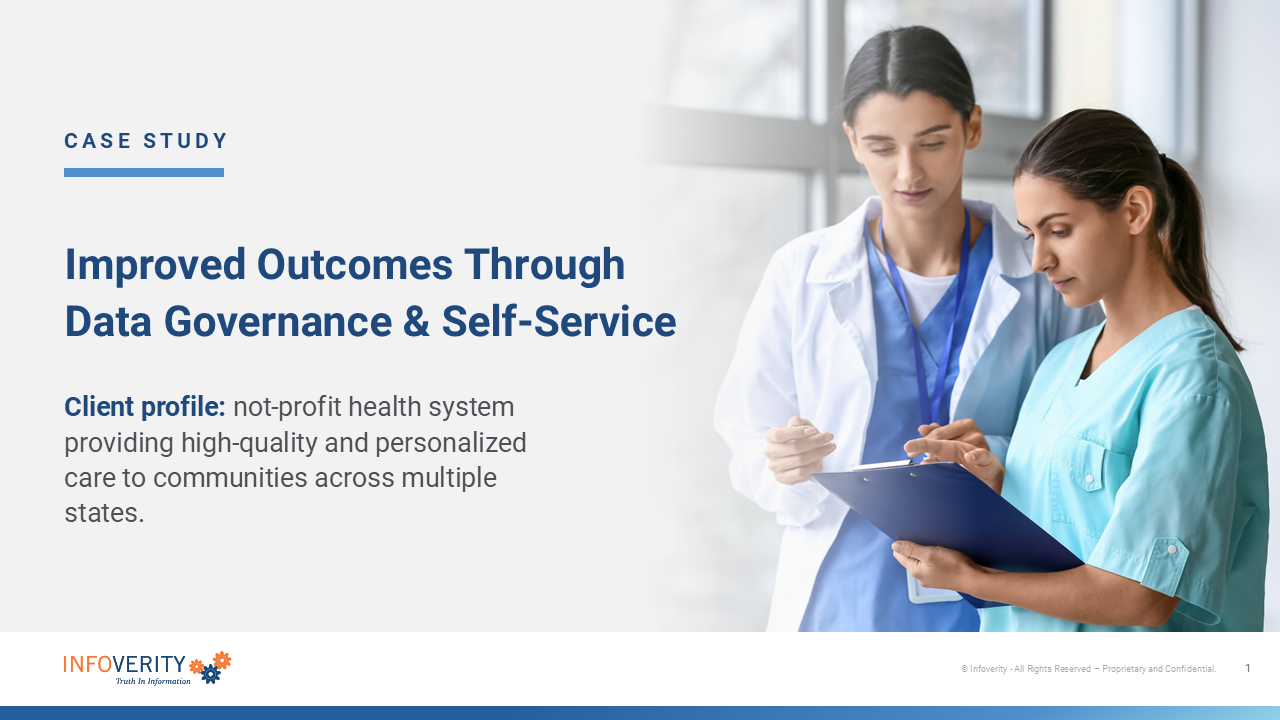
Discover how Infoverity helped improve outcomes through Data Governance and Self-Service using Databricks and Informatica MDM.
Architecture, build, and migration to cloud data warehouse and lakehouse environments. Designed for the analytics load you have today and the AI workloads you will add next.
The pipelines that move data from your source systems into your platform reliably, at scale, with the lineage your governance and AI programs need. Real-time and batch, across every system that matters.
Semantic layer design, KPI framework development, data catalogue implementation, and BI tool configuration. Business users reach the data they need. The analytics team focuses on analysis, not extraction.
A focused engagement that evaluates your current data platform against the AI use cases on your roadmap, identifies what is blocking production deployment, and sequences the work to close those gaps.
Governed KPI logic embedded in the tools and workflows your teams already use. Operational decisions made on live data, not yesterday's export.
End-to-end deployment of machine learning and large language model applications on your governed data platform. From proof of concept through production, on infrastructure your data team understands and can maintain.
Ready to make your data work as hard as your business needs it to?
Speak with an Infoverity analytics and data platform advisor. In 30 minutes we will walk through where your data intelligence stands today, what it needs to support, and the most direct path to getting there.
No obligation — a 30-minute conversation to understand where you are and what your data and AI goals require.

