Claims fraud detection. Underwriting automation. Customer lifetime value. The AI use cases that matter to insurance carriers all run on one thing: a single, governed view of the policyholder. Most carriers do not have one. We build it.













The high-value AI use cases in insurance (claims fraud detection, underwriting risk scoring, customer lifetime value, document intelligence on claims) operate on the same core entities the business already struggles to govern: the policyholder, the policy, the claim.
Policy-centric systems are designed around policies, not customers. Customer data ends up fragmented and duplicated across policies, and in many cases compounded by siloed policy administration systems, particularly between P&C and Life lines of business. Industry research has consistently found that most insurers are still working to build a single customer view. Until that gap closes, AI models trained and scored on inconsistent data will produce inconsistent outputs.
Infoverity builds the policyholder master data, governance, and quality foundation insurance AI depends on, and delivers the AI strategy, design, and deployment work that turns it into business outcomes.

The reason insurance AI projects stall is rarely the model. It is the foundation underneath it. Here is how Infoverity addresses both, in the same engagement.
We start with the AI use cases that matter to your loss ratio. Our Data Readiness Maturity Model tells you exactly where your foundation stands against each one. You get a tactical AI/ML roadmap, model recommendations, gap analysis, and ROI estimation including time to first value.
Every high-value AI use case in insurance ends up answering a question about a policyholder, a policy, a location, or a claim. We deliver the governed, deduplicated, enriched master data that makes those answers reliable. Without it, every AI application has to solve entity resolutions on its own. And they will solve it differently every time.
Our Data Readiness Maturity Model evaluates six dimensions: governance, quality, master data, metadata, architecture, and lineage. It tells you which level you are at, which use cases that level supports, and which priority actions move you up.
Our AI Strategy and ROI Analysis engagement runs two to four months, with four to six weeks dedicated to identifying high-impact use cases. You leave with a tactical AI/ML roadmap and a quantifiable estimate of the return.
These are the questions that decide whether an insurance AI roadmap reaches production or stalls in pilot. Short answers below, drawn from how we have delivered.

We run a structured AI Strategy and ROI Analysis. Five steps: define AI vision, assess readiness, identify high-impact use cases, develop a tactical AI/ML roadmap, quantify ROI including time to first value. Two to four months end to end. Four to six weeks of that on use case identification alone.

This is the exact pattern we addressed at Wawanesa Insurance. Five duplicated data sources across personal P&C and Life lines of business. We deployed Informatica SaaS MDM (IDMC) sourcing member data from both Policy Administration Systems, mastered individual policyholders and policies, and delivered clean trusted data to the downstream warehouse and analytics systems.

The EU AI Act and emerging US state-level AI regulations are establishing accountability for AI-generated decisions. Organizations cannot demonstrate compliance if they cannot trace AI outputs back to governed, auditable source data. We build the data governance and lineage that closes the gap.

This is what our AI Strategy and ROI Analysis is built to solve. Deliverables include a tactical AI/ML roadmap with model recommendations and gap analysis, plus an ROI analysis with time-to-first-value metrics. Stakeholders get a quantifiable estimate of return, not a promise.
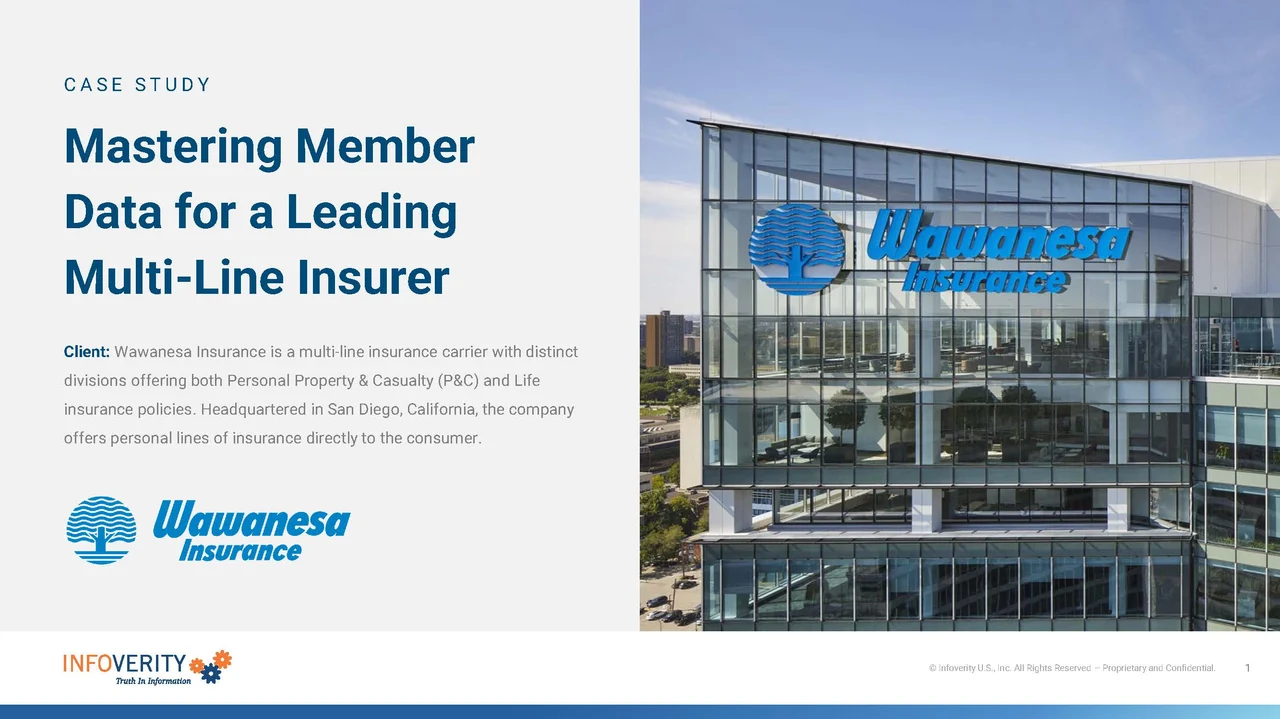
Five duplicated data sources across personal P&C and Life lines. No trusted member view. See how Infoverity built the MDM foundation on Informatica IDMC, and the analytics capability for lifetime value, churn, and fraud detection it unlocked.
Two to four months. Defines AI vision, assesses readiness, identifies high-impact use cases, develops a tactical AI/ML roadmap, quantifies ROI including time to first value.
Six to eight weeks. Develops proof-of-concept AI models for defined use cases, with scalability and deployment analysis so the solution can move into production.
Custom API and integration development to embed AI models into existing business processes. Ongoing support and maintenance to keep AI solutions running at performance and scale.
A governed, deduplicated view of the policyholder across P&C, Life, and commercial books. Delivered on Informatica IDMC, Reltio, or Stibo Systems depending on architecture fit.
Governance frameworks, data quality programs, lineage, and compliance readiness, extended to cover AI outputs alongside data inputs. The foundation that keeps every downstream AI decision traceable.
Cloud data platform design and migration (Snowflake/Databricks on Azure, AWS or GCP). Data integration and pipelines. Self-service BI. LLM and ML model deployment. Responsible AI frameworks.
Ready to put your insurance AI on a data foundation that holds?
We start with where you are: your current AI investments, your data estate, where the gaps are. In 30 minutes, you get a clear view of what’s holding your program back and what a practical next step looks like.
No obligation — a 30-minute conversation to understand where your AI and data strategy stands and where it could go.

