
Infoverity partnered with VirtuAlly to upgrade critical 24/7 patient monitoring operations by moving away from manually maintained Excel tracking and implementing a Databricks-powered application with automated KPI dashboards—improving operational speed, data consistency, and real-time visibility for teams supporting high-risk patients.
Highlights: What VirtuAlly achieved with Infoverity
- Replaced spreadsheet-driven workflows with a secure, scalable platform purpose-built for 24/7 patient monitoring operations.
- Delivered real-time KPI visibility in the flow of work by embedding Databricks dashboards securely via iframes within the application.
- Reduced average onboarding time from ~10 minutes to ~1–2 minutes per patient—an estimated 80–90% improvement based on dashboard-calculated metrics compared to prior Excel-based calculations.
- Improved operational confidence and reduced variability by standardizing onboarding workflows and enabling real-time metrics.
- Strengthened support for high-risk patients requiring continuous, 24-hour monitoring.
When strategy, execution, and partnership come together, teams can modernize more than technology—they can modernize how work gets done. That’s the story behind Infoverity’s collaboration with VirtuAlly, a healthcare virtual patient monitoring organization operating in an environment where high-risk patients require continuous, 24-hour monitoring by Virtual Safety Officers (VSOs).
VirtuAlly had a clear vision: move beyond legacy, manually maintained spreadsheets, reduce operational friction in critical workflows, and improve real-time visibility into the KPIs that matter most for a 24/7 monitoring operation. Infoverity’s role was to help guide that vision into a secure, scalable reality—built for speed, accuracy, and sustained operational performance.
Infoverity + VirtuAlly: Modernizing Patient Monitoring Workflows - Table of Contents
What business goals did VirtuAlly set for workflow modernization?
VirtuAlly’s goals centered on outcomes that directly affect 24/7 operations and frontline teams:
- Improve the speed, accuracy, and visibility of 24-hour patient monitoring operations.
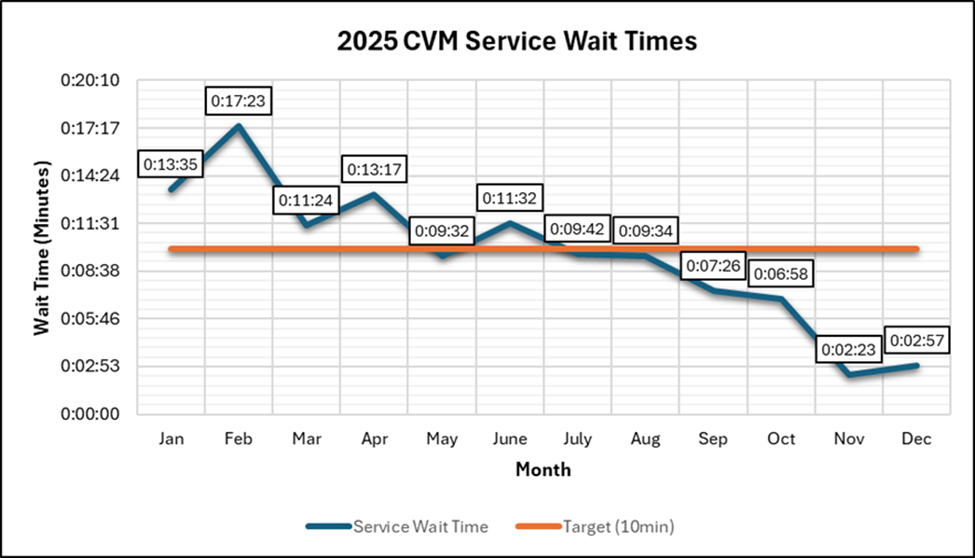
- Increase efficiency in patient onboarding and improve service wait times through standardized workflows and real-time metrics.
- Enable better, faster operational decision-making with timely KPI visibility across locations and shifts.
What challenges were slowing down accurate, efficient 24/7 monitoring operations?
Before modernization, VirtuAlly relied on manually maintained Excel spreadsheets for admitting patients, tracking monitoring activity, and managing discharge workflows in near real time—creating constraints that became more costly in a 24/7 environment.
Key challenges included:
- High manual effort and inconsistent data entry during patient onboarding.
- Elevated risk of data errors in a continuous monitoring setting.
- Limited scalability as patient volumes and monitoring programs expanded.
- Delayed visibility into operational KPIs across locations and shifts.
How did Infoverity show up as a partner (not just an implementer)?
In a high-risk, always-on operational model, modernization needs to do more than “replace a tool”—it has to reinforce consistency, confidence, and visibility for teams working in near real time.
Infoverity partnered with VirtuAlly to help modernize these critical workflows by replacing spreadsheet-driven processes with a scalable architecture that supports real-time KPI visibility and standardized onboarding workflows—so teams can move faster with greater confidence.
What solution did Infoverity implement?
Infoverity helped VirtuAlly move away from legacy, Excel-based onboarding and service wait time tracking by implementing Databricks as a centralized, governed data platform and building a Databricks-powered application supported by automated KPI dashboards.
To ensure the solution could scale with VirtuAlly’s 24/7 operating model, the team designed a scalable data model for continuous patient monitoring workflows—intentionally built to support future expansion (including additional monitoring attributes, longer observation windows, and new care programs) without requiring architectural redesign.
To keep performance insights available in the flow of work, Databricks dashboards were embedded and shared securely via iframes, delivering real-time KPIs directly within the application experience.
What results did VirtuAlly achieve?
With the Databricks-powered application and embedded KPI dashboards in place, VirtuAlly saw measurable improvements across operational efficiency, analytics trust, and frontline execution—especially in a 24/7, high-risk monitoring environment.
Operational and analytics improvements
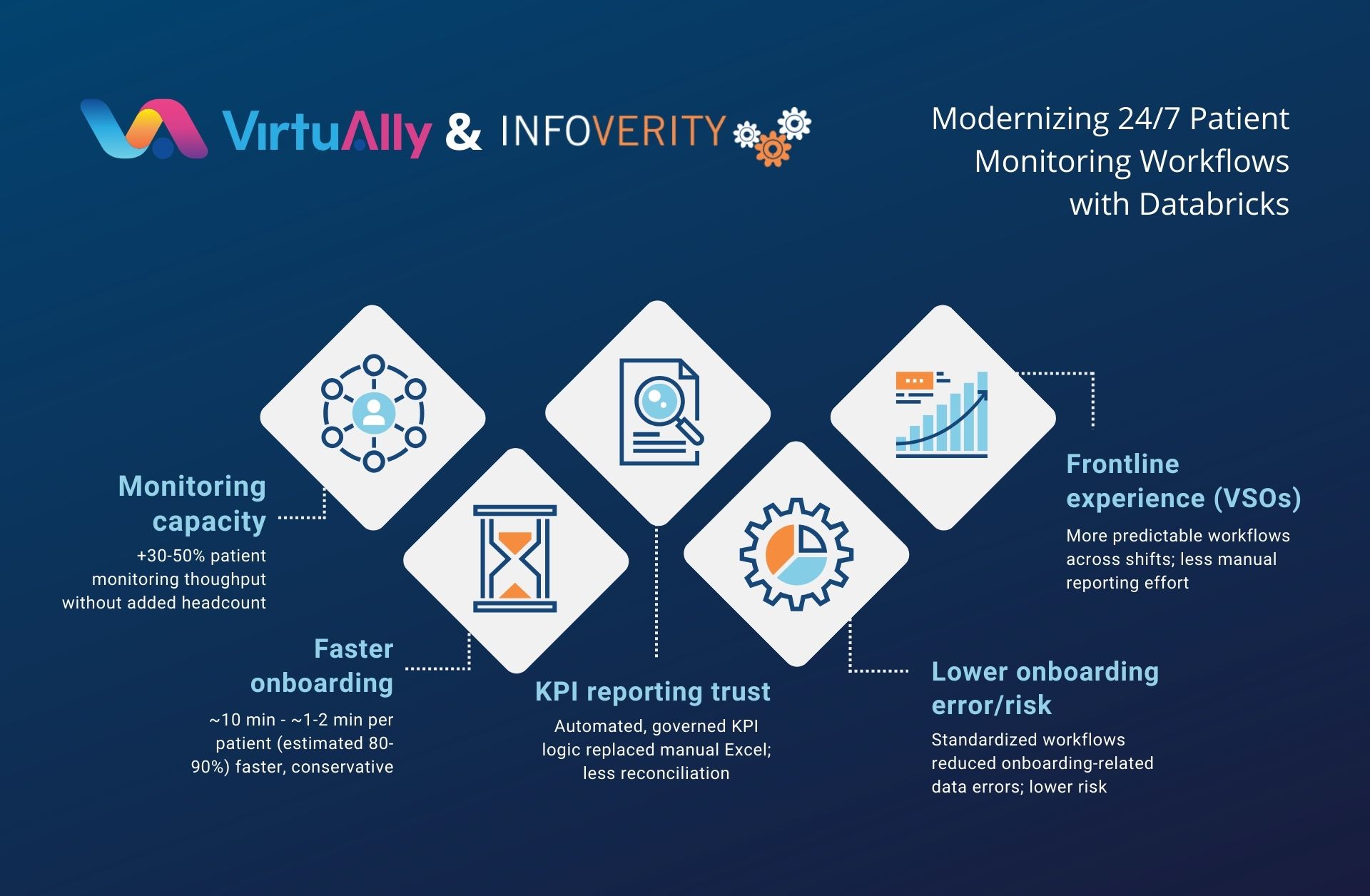
- Higher monitoring capacity without added staffing. VirtuAlly achieved a 30–50% increase in patient monitoring throughput, enabling teams to support more monitoring volume without increasing headcount.
- Fewer onboarding-related errors and lower operational risk. Standardized workflows helped reduce onboarding-related data errors, lowering risk in continuous monitoring scenarios where accuracy is critical.
- More reliable KPI reporting. By replacing manual Excel calculations with automated, governed KPI logic, VirtuAlly significantly improved trust in reported metrics and reduced the need for manual reconciliation.
Onboarding efficiency and service wait-time impact
- Faster onboarding (key driver of wait time). Average onboarding time fell from approximately 10 minutes to 1–2 minutes per patient, based on dashboard-calculated metrics compared to prior Excel-based calculations.
- Conservative estimated improvement. This corresponds to an estimated 80–90% improvement in onboarding speed, supported by operational feedback and observed trends.
- Reduced delays and variability. While service wait time is influenced by multiple factors, VirtuAlly reported a clear positive impact from standardized onboarding workflows and real-time dashboard visibility, helping reduce delays and variability.
Frontline experience improvements (VSOs)
- More predictable workflows across 24-hour coverage. Virtual Safety Officers (VSOs) benefited from faster, more consistent onboarding, improving handoffs across shifts.
- Less manual reporting effort. Real-time dashboards removed the need to manually calculate or reconcile wait times, allowing staff to focus more on patient safety and monitoring execution.
Why this Infoverity + VirtuAlly success story matters
This isn’t only a technology upgrade, it’s an example of how replacing manual tracking with standardized workflows and real-time KPI visibility can strengthen a 24/7 operating model. For VirtuAlly, it translated into faster onboarding, clearer performance insight, and stronger support for high-risk patients who require continuous monitoring.