Every data and AI project we run builds in change readiness, enablement, and adoption from day one. A project that’s technically successful but never adopted isn’t a successful project — so we don’t treat the people side as optional.













When change support shows up after the technical design is locked, it spends its time managing resistance instead of preventing it.
A separate line item is the easiest thing to trim under budget pressure — and the client rarely feels the cost until adoption stalls, months after go-live.
A standalone change practice that doesn't understand the systems, data, and workflows underneath the change can only offer advice that sits above the work, not inside it.
Embedding change management changes what you have to coordinate, staff, and pay for.
Change activities are line items inside the same plan, sequenced against the same milestones — not a parallel workstream your team has to manage separately.
Most change management support is written by people who never touch your systems. Ours is written by the same consultants who are already inside your data, your governance model, and your workflows — so the training, communication, and adoption plan describe what your teams will actually see on the screen, not a generic template.
That’s a moat a standalone change management firm, or an AI-only vendor, can’t replicate. It’s why we deliver technology, process, data, AI, and adoption as a unified transformation, with the people side embedded from day one rather than treated as a separate workstream.
Four patterns we see again and again. They start with the master data and end with what it makes possible.

A platform go-live is not the same as a working MDM program. Our Operational Excellence model sustains performance, handles enhancements, and applies AI to the operational work itself. One enterprise program runs at more than a million API calls per day at sub-300ms response times, including LLM-assisted merge request processing.

Most enterprises live with master data that is technically present and operationally unreliable. We diagnose where the discrepancies live, design the data model and stewardship process that fix the root cause, and stand up the matching, governance, and integration layers that keep the master record trusted over time.
Almost always, it is the data. Customer entities are duplicated, product attributes are missing, supplier records are inconsistent. We diagnose where the data foundation is breaking the AI use cases, then sequence MDM and AI as one program so the next pilot ships.

AI governance and data governance are converging fast. When AI outputs trace back to governed master data, accountability becomes possible, and so does the audit trail your regulators, board, and customers will increasingly ask for. We design both as one program.
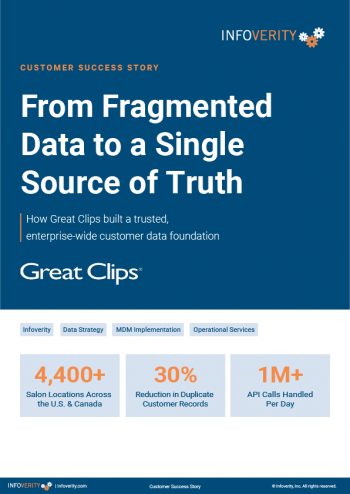
Infoverity led three consecutive phases: enterprise data strategy, full implementation of Informatica Customer 360 MDM SaaS, and ongoing operational services. The result is a single authoritative customer record: deduplicated, address-validated, CCPA-compliant, and delivered reliably to every system that depends on it. LLM-assisted processing now handles stylist merge feedback at scale, putting AI to work on the operational data quality that keeps the platform accurate.
Build the deduplicated, governed customer master that powers reliable analytics, marketing personalization, and customer-facing AI. The foundation for recommendation engines, AI service agents, and accurate compliance response.
A single, enriched product record across channels and markets. Product data that supports omnichannel commerce today, and AI-powered search, generative product descriptions, and AI shopping agents tomorrow.
Master supplier, location, and reference data to support procurement analytics, supply chain risk modelling, and the AI use cases that depend on knowing who and where you are buying from.
Post-launch is where most data programs stall. Our Operational Excellence model sustains performance, handles enhancements, and applies AI to operational data work itself, so the foundation under your business keeps strengthening.
Governance is what keeps master data trustworthy after go-live. We design the operating model, roles, and policies that hold up under regulatory pressure and make AI outputs auditable when the question comes.
From use case prioritization through production deployment of generative, predictive, and agentic AI. The advantage: the master data the AI needs is already in our hands.
Ready to align your people around your data and AI initiative?
Speak with an Infoverity advisor. In 30 minutes we will walk through where your master data sits today, the analytics and AI it needs to support, and the most direct path between the two.
No obligation — a 30-minute conversation to understand where you are and what your data and AI goals require.

