
77% of organizations polled by PwC confirmed that growing compliance complexities have negatively impacted several areas that drive growth. In such a landscape, heavy and policy-driven traditional data governance approaches fall short and leave institutions exposed.
Visionary Chief Data Officers (CDOs) know that compliance and competitive advantage are intertwined and that they both rely on strong data governance practices embedded directly into business processes. Rather than imposing rigid policies, modern data governance empowers organizations to leverage data while ensuring quality, security, and compliance.
In this article, we unveil the ultimate roadmap to help you transform your data governance in financial services. We will challenge traditional mindsets and share practical insights to unlock strategic advantage and compliance excellence.
No time to read?
Listen on the go — skip the scroll and absorb the insights hands-free. This post is part of Infoverity’s Audio Blog Archive — built for busy professionals like you.
Data Governance in financial services: Table of Contents
Why Traditional Data Governance Falls Short in Today’s Financial Marketplace
Financial institutions still relying on legacy data governance practices face significant challenges, including fragmented data and increased operational and compliance risks.
Regulations such as the General Data Protection Regulation (GDPR) and the California Consumer Privacy Act (CCPA), along with standards like the Payment Card Industry Data Security Standard (PCI DSS), require a proactive and modern approach to Data Management, emphasizing privacy, security, and transparency.
Achieving these principles requires adopting advanced data governance frameworks that centralize Data Management, strengthen security, streamline compliance, and minimize risks. Without these frameworks, organizations may struggle to provide timely insights and face vulnerabilities due to inefficiencies in their current systems.
Leaders must therefore continually evaluate their data governance strategies to ensure they can meet current challenges and regulatory demands, asking themselves: “Are we prepared to meet today’s challenges?”
Connecting the Dots: Data Governance as a Strategic Imperative for Competitive Advantage
Data governance frameworks for banks are more than just exercises. They are a strategic imperative for competitive advantage. Leading banks leverage modern governance frameworks to go beyond mere compliance. With AI, they transform raw data into real-time insights and predictive modeling at scale. They streamline risk management and create innovative customer-centric offers.
A robust data governance framework for banks enhances customer interactions, spurs innovation, and increases organizational agility, allowing them to adapt quickly to market changes.
These institutions anticipate customer needs and deliver highly-tailored solutions, outperforming competitors that rely on outdated processes. For them, data governance in financial services is no longer a chore. It becomes an essential strategic tool for growth and success.
Key Components of a Successful Data Governance Framework for Banks
To thrive, banks need to implement a specialized, scalable data governance framework explicitly designed to address the present complexities of financial operations.
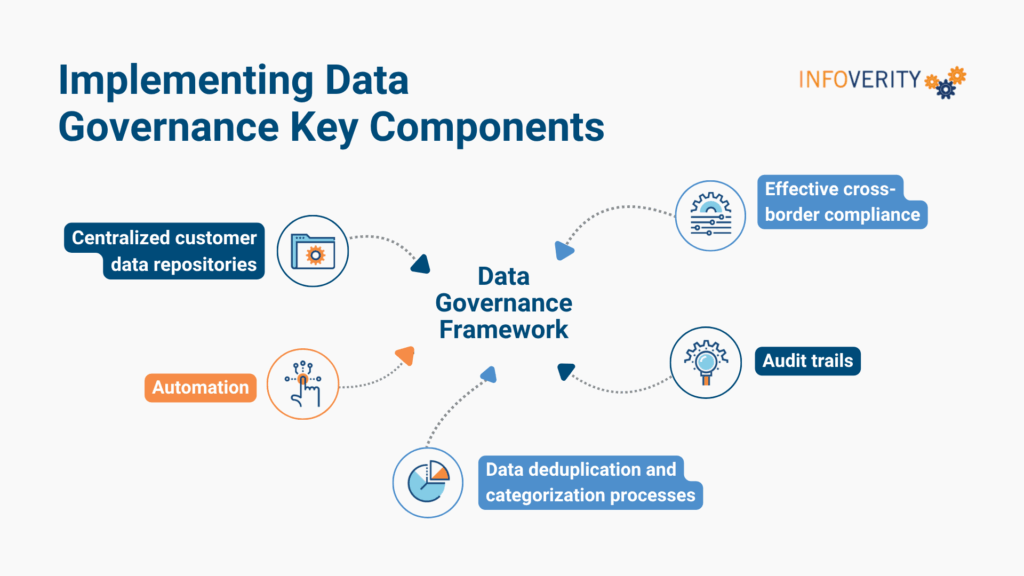
Thus, most industry leaders have integrated into their frameworks key components such as:
- Centralized customer data repositories. These centralized data pools and single customer views significantly enhance data trust, improve compliance audits, and streamline operations.
- Data deduplication and categorization processes. Eliminating duplicated information, analyzing and organizing data based on sensitivity and relevance to data privacy, facilitates risk mitigation and provides more accurate insights that improve decision-making.
- Automation. Automated data flows foster agility and assure consistent regulatory adherence across all banking platforms.
- Audit trails. Comprehensive and regular audit trails help you keep up with evolving industry regulations and standards.
- Effective cross-border compliance. Organizations with international operations must ensure compliance across regions. A robust cross-border framework lets you address both stringent regulations and cross-regional requirements.
Evaluate your current frameworks. If they don’t incorporate these essential elements, it is time for a change.
Achieving Compliance Excellence: Turning Regulatory Pressure into Opportunity
Although regulation and compliance in financial services may seem daunting at first, forward-thinking banks perceive regulations as an opportunity. They view them as a possibility to enhance corporate governance processes, bolster reputation, and gain strategic advantages.
By implementing comprehensive data governance best practices in financial services, these successful institutions minimize the risk of non-compliance, reduce fines, and transform compliance from mere costs into an essential business catalyst. Leading banks:
- Turn compliance excellence into operational efficiencies and distinctive market advantages.
- Remain competitive by leveraging proactive governance frameworks to meet current regulatory requirements while anticipating changes.
- Gain a significant edge by shifting from a reactionary to a proactive approach in governance.
Ultimately, embracing compliance as a strategic asset empowers these successful banks to navigate challenges and complexities with confidence, fostering innovation while demonstrating commitment to transparency and responsibility.
The Time to Act is Now: Elevate Your Data Governance Strategy
For financial institutions and compliance officers, the stakes today are higher than ever before. High-performance banks recognize the urgency of governance transformation to attain strategic clarity, sustained compliance, and greater agility.
They understand that organizations that optimize their data governance strategy can maximize the business value generated from their data assets.
By embracing proactive governance transformation, they unlock increased revenues, enhanced customer experiences, reduced operational costs, and competitiveness. However, those who delay embarking on this transformation journey face serious risks, including high costs, heavy fines, missed opportunities, and a tarnished brand reputation.
Elevating your data governance strategy is not just beneficial. It is essential for survival and growth. The time to act is now. Invest in modern, effective governance strategies. You will be better equipped to navigate challenges and seize opportunities, ensuring long-term success.
Partnering with Infoverity – Transforming Data Governance for Financial Institutions
Why do visionary Chief Data Officers choose Infoverity to revolutionize their approach to data governance in financial services? At Infoverity, we don’t just advise. We strategically partner with you on purposeful transformations that fuel measurable growth and efficiency. We transform our financial clients’ data governance into a strategic advantage.
As a globally recognized expert in Data Management, Business Intelligence, and AI, we help banking institutions shift their data governance from a compliance necessity to a golden opportunity offering:
- Comprehensive solutions ranging from the design of data governance frameworks to the deployment of AI-driven analytics.
- Years of expertise in navigating compliance regulations, including GDPR and PCI DSS, across various regulatory landscapes.
- Proven success in integrating disparate data environments and enhancing regulatory compliance for leading financial institutions worldwide.
- Extensive experience in working with complex legacy systems to ensure seamless Data Management.
Take bold steps toward leadership in the data governance financial services landscape with us. Let Infoverity help you elevate your data governance strategy. Contact us today!
FAQ – Data governance in finance
Where does the importance of data governance lie for financial services?
Financial institutions still relying on legacy data governance practices face significant challenges, including fragmented data and increased operational and compliance risks. Leaders must therefore continually evaluate their data governance strategies to ensure they can meet current challenges and regulatory demands.
What are the key components of a successful data governance framework?
A successful data governance framework includes centralized data repositories for trust and efficiency, automation for agility and compliance, deduplication to improve accuracy, audit trails for regulatory alignment, and cross-border compliance to meet international standards.
How to achieve compliance excellence?
By implementing comprehensive data governance best practices in financial services, successful institutions minimize the risk of non-compliance, reduce fines, and transform compliance from mere costs into an essential business catalyst.
How to transform data governance for financial companies?
At Infoverity, we don’t just advise. We strategically partner with you on purposeful transformations that fuel measurable growth and efficiency. We transform our financial clients’ data governance into a strategic advantage. As a globally recognized expert in Data Management, Business Intelligence, and AI, we help banking institutions shift their data governance from a compliance necessity to a golden opportunity.