
CDP for Paid Media – Highlights
- Improve CPA and ROAS by focusing spend on higher‑intent segments and reducing inefficient reach.
- Build stronger lookalikes by seeding media platforms with high‑quality audiencies instead of broad or generic lists.
- Cut waste by suppressing advertising to recent purchasers, low‑value cohorts, and customers with open support cases.
- Reduce manual effort by replacing list pulls and uploads with automated audience refreshes.
- Measure impact credibly by comparing performance against baseline metrics.
Customer Data Platforms (CDPs) are frequently viewed as first-party data & direct marketing engines. While that’s true, organizations that invest in a CDP quickly encounter a second set of questions: How can we use our CDP for paid media? Is there real value in doing so? And where do we start?
CDP for Paid Media: Table of contents
Why activate CDP segments in paid media?
Activating CDP segments across paid media channels helps marketing teams reduce wasted spend and focus their investments on the audiences most likely to convert, while also reducing the operational drag that comes with manual list pulls and uploads.
When set up well, CDP‑driven paid media activation delivers improvements across several areas including tighter targeting and retargeting, stronger lookalike seeding, smarter ad suppression, and far less time spent on manual steps to keep audiences current.
How does a CDP improve targeting and retargeting?
Targeting is only as strong as the first‑party signals available. CDPs enable organizations to identify customers showing high intent through offline and online engagement, progressing through lifecycle stages, or demonstrating product or category affinities, and then activate these signals across channels such as Google Ads, Meta Ads, LinkedIn, and other destinations.
Effective targeting and retargeting become even more important in an omnichannel buying journey. McKinsey’s research shows that more than half of B2C customers use three to five channels every time they make a purchase or resolve a request, and even a simple task like booking accommodations can require switching nearly six times between websites and mobile channels. When information or messaging is inconsistent across those touchpoints, customers disengage quickly.
A CDP helps prevent this disconnect by unifying identity and behavioral signals across channels, allowing retargeting efforts to reflect where someone actually is in their journey (and what they’ve already done) rather than treating every customer the same.
How do CDP audiences make lookalikes more effective?
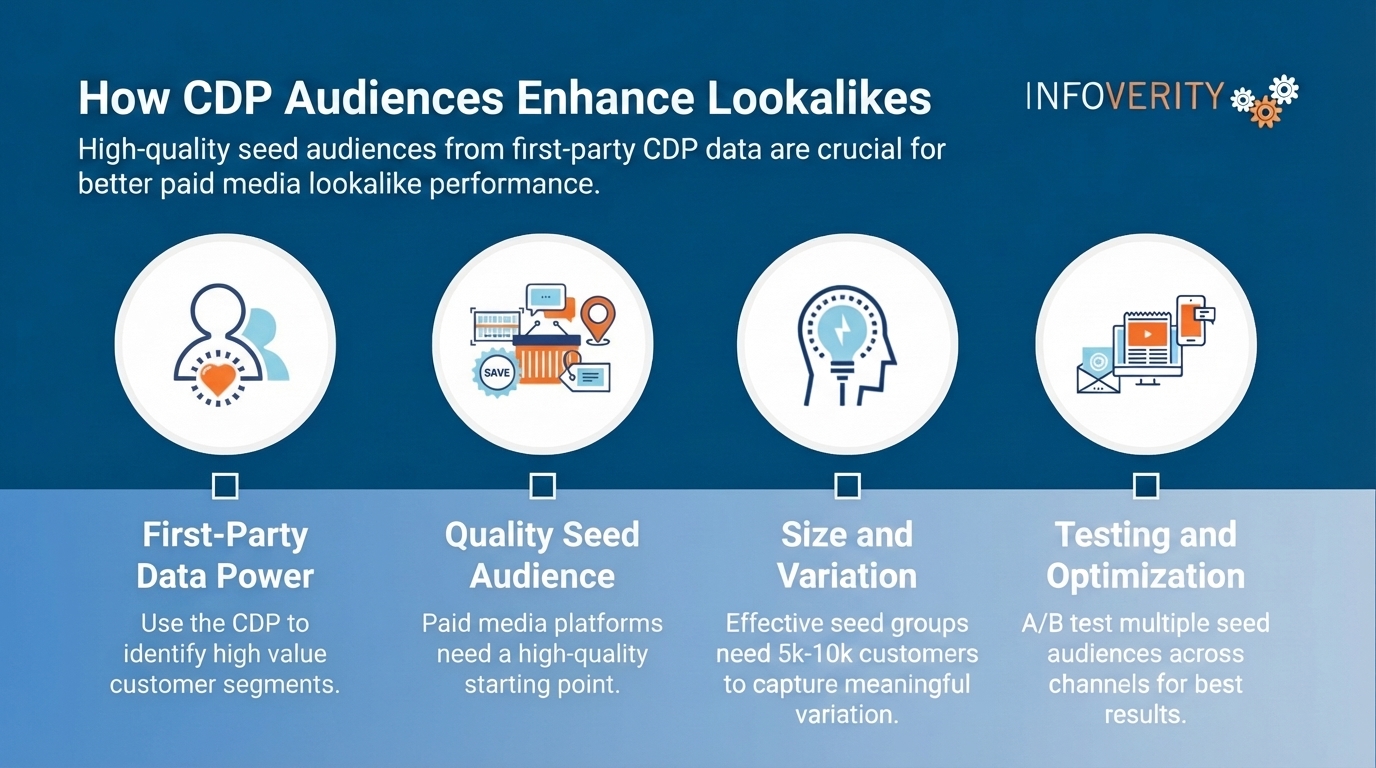
Most teams underestimate how heavily lookalike performance depends on the quality of the seed audience. Paid media platforms offer strong lookalike modeling, but they still require a high‑quality starting point. CDPs make it possible to build seed groups from your own first‑party data—high‑value customers that paid media platforms can then use to find more people who resemble them.
In practice, effective first‑party seed audiences need to be large enough to capture meaningful variation, typically with a minimum of 5,000–10,000 customers. Strong candidates for seed groups include high‑LTV customers, repeat buyers within a category, or customers who move quickly from first to second purchase. It’s also good practice to A/B test multiple seed audiences across channels to determine which performs best for each product or campaign.
How does a CDP reduce waste with suppression?
Paid advertising is typically a larger budget item for marketing teams, so every dollar needs to work efficiently. If targeting and lookalike seed audiences help you reach the right customers, suppression helps ensure you don’t spend money reaching the wrong ones.
For most organizations, suppressing recent purchasers, low‑value cohorts, and customers with active support cases is an effective way to optimize paid spend. For businesses that sell lower‑volume, high‑price products or operate with longer purchase cycles, the financial impact of suppression may be less dramatic, but excluding recently converted customers still matters for delivering a positive experience. No one wants to keep seeing ads for something they just purchased.
Beyond budget efficiency, suppression protects customer trust by ensuring messaging stays relevant and aligned with where each customer is in their journey.
How does a CDP streamline paid media operations?
Even on sophisticated paid media teams, manually exporting, reconciling, and uploading audience lists—along with troubleshooting formatting issues and questioning whether the data is even accurate—quickly becomes a major time sink. And in most cases, the same work repeats week after week.
Research from DoubleVerify in 2025 found that marketing teams spend roughly 10 hours per week per employee on manual campaign execution tasks. Connecting your CDP directly to paid media channels dramatically reduces this operational lift by centralizing audience refreshes from a single, trusted source of customer data. The time saved can be redirected toward higher‑value work such as campaign strategy, measurement, testing new messaging, and iterating on creative.
Which paid channels should you connect to the CDP first?
Most enterprise marketing teams operate across ten or more digital channels. When deciding which channels to connect first, it’s best to begin where your ad spend is already concentrated. Most teams begin with Google Ads and Meta Ads because these destinations anchor performance marketing programs and offer mature audience‑activation workflows.
After that, expand only after demonstrating value and operational stability. It’s also important to test and validate new channels before turning on full CDP activations, since each additional destination introduces new monitoring, QA, and governance requirements.
How do you measure ROI?
Most paid advertising platforms offer reporting and analytics, but they rarely provide full transparency. This means measurement should focus on what is reliable, such as audience-level performance changes, waste reduction through suppression, and operational impact.
The most important step in evaluating paid media ROI is to establish a reliable baseline. Record current CPA, ROAS, and conversion rates by channel, and where possible by audience strategy. Document how retargeting and lookalikes perform today and quantify the time your team spends on manual audience work. Then measure changes against this baseline over time.
When volume allows, include incrementality validation. Platform experiments and conversion lift studies are ideal when available, and audience holdouts are a practical alternative. The goal is not academic perfection. The goal is credible evidence that CDP-driven audiences are improving outcomes beyond what your baseline already delivers.
FAQ – CDP for Paid Media
What are the benefits of activating CDP audiences to paid media channels?
Activating CDP audiences into paid media channels improves efficiency and effectiveness of advertising spend. Benefits include better targeting, reduced ad waste through smarter suppression, and less manual campaign effort via automated audience delivery.
Do I need to connect every paid channel to my CDP?
No. Start with the destinations that already drive meaningful results or where CDP activation will clearly improve performance or reduce operational friction. Test new channels in controlled pilots before fully productionalizing CDP activation to additional destinations.
What’s considered a “good” audience match rate?
It varies by platform, identifier type, data hygiene, and audience composition. Match rates anywhere from 30% to 90% can be normal. The priority should be improving match quality over time through better data hygiene and stronger seed audiences—not chasing a single benchmark across platforms.
Does paid media activation look different for B2B versus B2C organizations?
Yes. A major factor is the type of identifiers in your first‑party data. Work email addresses typically won’t match on paid social platforms, which can limit reach for B2B audiences. It’s important to understand where your customers or prospects actually spend time—platforms like LinkedIn may be more effective for B2B, while channels such as Pinterest, Meta, or TikTok might align better with B2C behaviors.
How should I measure ROI for CDP paid media activations?
Begin by establishing a baseline. Then evaluate improvements in audience‑level CPA, ROAS, conversion rates, and the value gained from suppression‑driven waste reduction. When possible, use holdout tests or platform experiments to validate incrementality and isolate the impact of CDP‑driven targeting.