
Are you ready to unlock the full potential of artificial intelligence (AI)? AI readiness isn’t just a buzzword, it’s your organization’s ability to adopt and integrate AI technologies effectively. Organizations that prioritize AI readiness gain a competitive edge, improve decision-making, and optimize processes, all while driving innovation and growth.
Key highlights from the blog:
- Critical components for AI readiness: From identifying clear value-add AI use cases to building robust IT infrastructure and ensuring data quality management, learn how these elements pave the way for successful AI adoption.
- Avoid common pitfalls: Poor preparation can lead to AI disasters. Discover how strategic planning, compliance, and training prevent missteps and ensure responsible implementation.
- Real-world insights: AI readiness fuels decision autonomy, drives efficiency, and generates value. Find practical steps to assess your current capabilities and close gaps effectively.
AI is transforming industries, so make sure your business is prepared to capitalize on this evolution.
AI Readiness: Table of Contents
In today’s rapidly advancing technological landscape, Artificial Intelligence (AI) plays a crucial role in driving business innovation and efficiency. AI readiness refers to an organization’s preparedness to effectively adopt and integrate AI technologies into its operations. This readiness is significant as it determines how well a business can leverage AI to enhance decision-making, optimize processes, and maintain a competitive edge.
By understanding and achieving AI readiness, businesses can unlock new opportunities for growth, improve their data management practices, and ensure long-term success in an increasingly digital world.
Understanding AI Readiness: Components and Importance
AI readiness is composed of several critical components that together determine an organization’s ability to effectively implement and leverage AI technologies. These components include:
- Clear Value Add Use Case. AI must be applied to something that will provide value to an organization. A chatbot is only useful if it frees up resources to do other tasks. The existing processes and time requirements must be know so that the impact of the AI can be evaluated and the ROI can be tracked
- Technology Infrastructure. A robust and scalable IT infrastructure that can support AI applications and handle large volumes of data is essential. This includes powerful computing resources, advanced storage solutions, and secure networking capabilities.
- Data Quality Management. High-quality data is the backbone of any successful AI initiative. This involves ensuring that data is accurate, complete, consistent, and timely. Effective data quality management practices, such as data cleansing, master data management, and data governance, are vital for maintaining data integrity.
- Enabled Personnel. A skilled workforce is crucial for AI readiness. This includes data scientists, AI engineers, and other professionals with expertise in AI and data management. Continuous training and development programs are necessary to keep up with the rapidly evolving AI landscape.
- Organizational Change Management. Inserting AI into a process or workflow is going to cause disruption. Understanding the existing resistance to change and appetite for change from key stakeholders is critical preparation for AI readiness. It leads directly into the necessary change management activities when an AI initiative is implemented.
- Security and Ethics Policies. AI applications come with increased privacy and ethics risks based on their architecture and ability to absorb open text prompts. Clear polices and protections need to be in place before beginning work on AI to limit risk exposure.
- Clear Strategic Plan. Wrapping up all of these aspects of readiness into a strategic plan with clear ownership and Time to Value (TTV) is critical for ensuring that technical, resourcing, and policy hurdles are cleared in preparation for an AI implementation.
Understanding these components helps organizations to identify gaps in their current capabilities and take proactive steps to enhance their AI readiness. This not only facilitates the successful deployment of AI technologies but also maximizes their potential to drive business efficiency and innovation.
Clear Value Add Use Cases
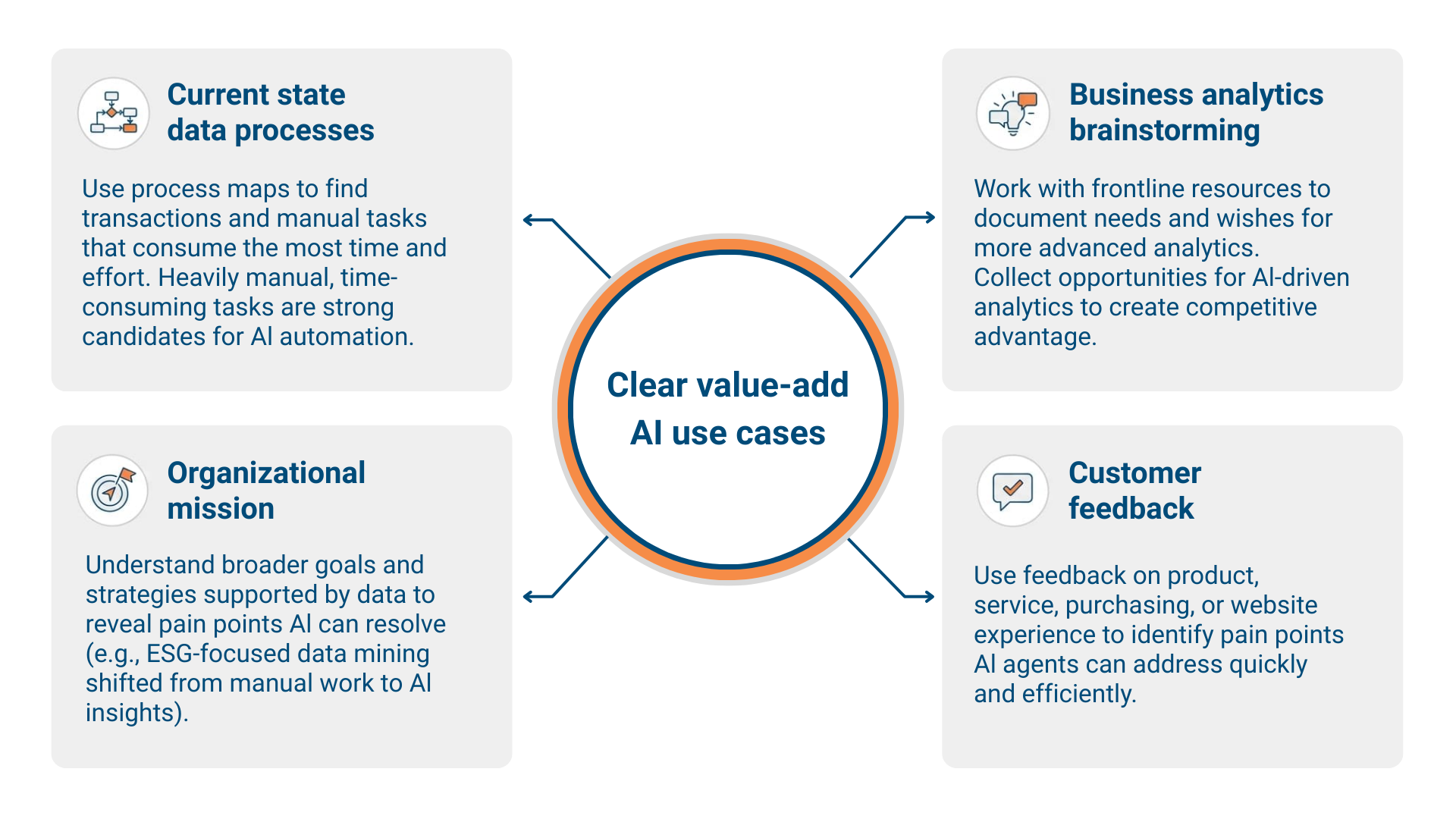
An AI application, no matter if it is complex or simple, must address a pain point and provide value to the organization. AI is an incredibly efficient tool for problem solving, it’s so efficient that it’s easy to apply to the wrong problems. The right preparation works to find the best place to apply AI will ensure the solution produces positive value for the organization. The best methods for finding the right AI value-add use case are:
- Current State Data Processes. Process maps show the transactions and manual tasks that consume the most amount of time and effort in a business process. Heavily manual and time-consuming tasks are great candidates for AI automation.
- Business Analytics Brainstorming. Work with the resources on the frontline of the business to document the needs and wishes for more advanced analytics to collect opportunities for advanced AI driven analytics to provide a competitive advantage for the organization.
- Organizational Mission.Understanding the broader organizational goals and strategies and how they are supported by data can highlight pain points that AI can resolve. For example, if an organization is leaning into ESG, what data mining can be shifted from manual resources to AI driven insights.
- Customer Feedback. Feedback from customers about their experience with the product, customer service, purchasing, or website provides valuable insight into pain points that AI agents could address quickly and efficiently.
Technology Infrastructure
Various technologies and tools can significantly enhance AI readiness, enabling organizations to effectively implement and leverage AI solutions. These include:
- Machine Learning Platforms. These tools facilitate the development, training, and deployment of machine learning models. Popular platforms include TensorFlow, PyTorch, and scikit-learn.
- Data Integration Tools. Solutions like Informatica, Ataccama, Boomi, Apache Nifi, and Talend help combine data from disparate sources, creating a unified and accessible data environment.
- AI-enhanced Data Management Tools. Tools such as Informatica, Alation, and Ataccama use AI to automate data management tasks, improving data quality and streamlining workflows.
By adopting these technologies, organizations can build a solid foundation for AI initiatives, ensuring that their data infrastructure is robust and capable of supporting advanced AI applications.
Data Quality Management in AI
Data quality management is a critical aspect of AI readiness, as the effectiveness of AI systems heavily depends on the quality of the data they process. Key elements of data quality management include:
- Data Quality Dimensions. These encompass accuracy, completeness, consistency, and timeliness. Ensuring these dimensions are measured is essential for reliable AI outputs.
- Data Cleansing. This involves identifying and rectifying errors, removing duplicate records, and standardizing data formats to ensure accuracy and consistency.
- Data Governance. Implementing policies and procedures to manage data assets effectively. This includes defining roles and responsibilities, setting data standards, and ensuring compliance with regulatory requirements.
- Data Quality Management Systems. Utilizing specialized software and tools designed to monitor, assess, and improve data quality continuously.
By prioritizing data quality management, organizations can ensure that their AI systems produce reliable insights and support informed decision-making. This, in turn, enhances overall business efficiency and effectiveness.
Enabled Personnel
Resources in the organization need to be able to create and maintain AI solutions. While, it is a simple process to set up an AI Agent, it is difficult to do it efficiently and safely. The organization should prioritize training for critical resources such as:
- IT Development Teams. Development teams need to be able to build and develop AI applications in such a way that they are efficient to run, and comply with existing organizational policies. All major AI platforms offer training courses.
- IT Infrastructure Team. The infrastructure team needs to understand the processing mechanisms, data ingestion, and data output methods for AI so that they can support the AI applications and ensure they do not consume too much computing cost. All major computing platforms offer AI training courses.
- Security and Compliance Team. This team should know the different mechanisms of AI and write clear policy and guidelines for how AI is allowed to be applied to data within the organization, this is especially true of PII and PHI.
- Governance Team. The governance team should understand what data is being used by AI applications so that it can ensure timely and quality data is being sourced.
Organizational Change Management
Closely tied to both the resource enablement and the value-add use case, the organization must be ready for the change that AI will bring. Technology solutions must be adopted to help solve an issue no matter how easy it is to use the solution:
- Know the Why. Know why the organization is investing in an AI initiative and be able to clearly and succinctly communicate the why to the organization broadly and to individual groups
- Communication Plan. Develop and execute a plan to communicate to the organization the upcoming benefits that the AI initiative will bring. Regularly communicate and celebrate progress to generate excitement for the AI solution
- Resistance to Change. Engage with the organization to understand the existing resistance to AI tools and its source. Formulate a plan to address those areas of resistance at the source
- Training. Ensure the organization is trained on the benefits and risks of using AI and are capable of leveraging the new solutions to their full potential
AI Compliance and Ethical Considerations
AI systems must navigate a complex landscape of compliance and ethical considerations to ensure responsible and lawful usage. Key aspects include:
- AI Compliance. Ensuring AI technologies meet regulatory standards and legal requirements. This includes data privacy laws, industry-specific regulations, and international guidelines.
- Ethical AI. Implementing AI in ways that uphold ethical standards, such as fairness, transparency, and accountability. This involves addressing biases in AI models, ensuring explainability of AI decisions, and maintaining user trust.
By focusing on these areas, organizations can mitigate risks, protect user rights, and foster trust in their AI systems. This not only enhances the ethical standing of the business but also ensures long-term sustainability and success in the AI-driven market.
Strategic Planning for AI Integration
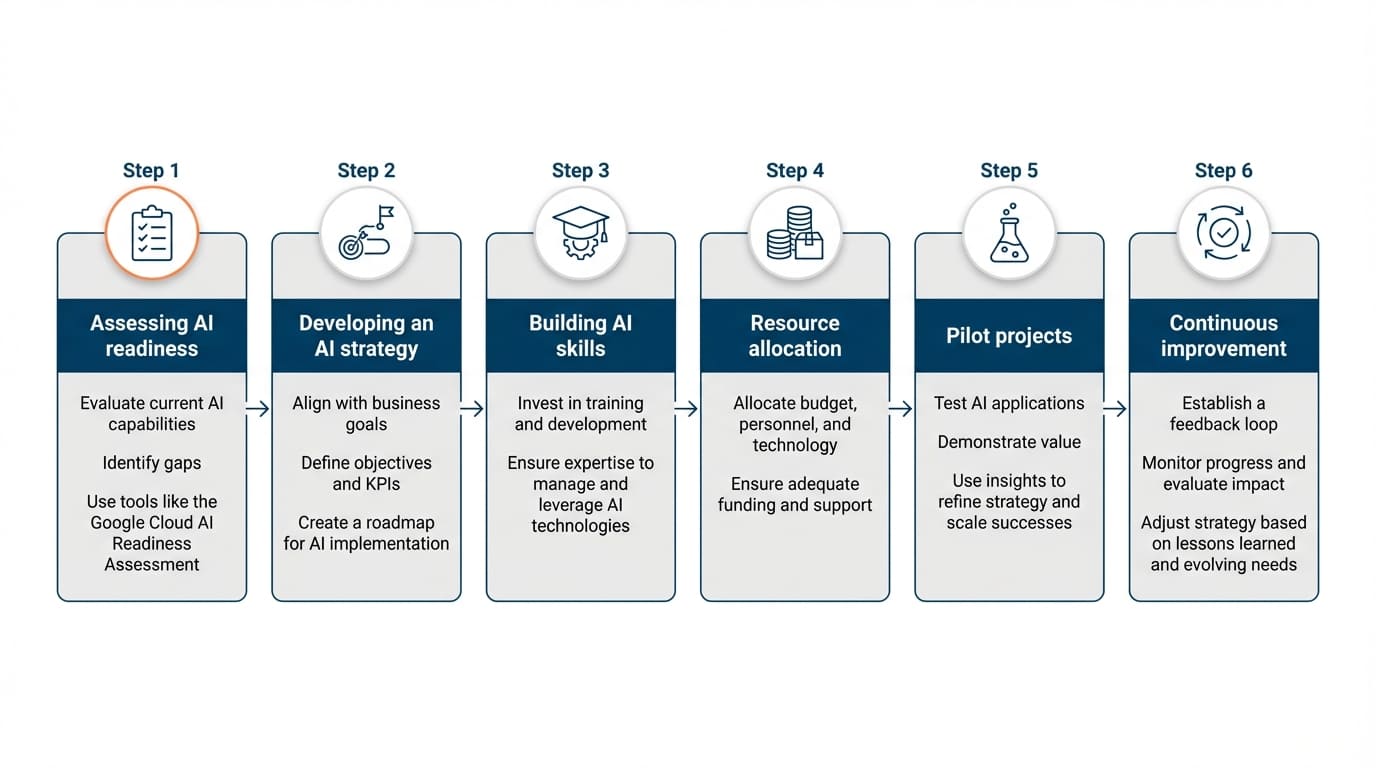
Strategic planning is essential for successful AI deployment. Here are key steps in the strategic planning process:
- Assessing AI Readiness. Begin by evaluating your organization’s current AI capabilities and identify gaps using tools like the Google Cloud AI Readiness Assessment.
- Developing an AI Strategy. Create a comprehensive AI strategy that aligns with your business goals. This should include objectives, key performance indicators (KPIs), and a roadmap for AI implementation.
- Building AI Skills. Invest in training and development programs to enhance AI skills within your organization. Ensure that your team has the necessary expertise to manage and leverage AI technologies.
- Resource Allocation. Allocate resources, including budget, personnel, and technology, to support AI initiatives. Ensure that adequate funding and support are in place for successful AI projects.
- Pilot Projects. Start with pilot projects to test AI applications and demonstrate their value. Use the insights gained from these projects to refine your AI strategy and scale up successful initiatives.
- Continuous Improvement. Establish a feedback loop to monitor the progress of AI initiatives, evaluate their impact, and make necessary adjustments. Continuously improve your AI strategy based on lessons learned and evolving business needs.
By following these steps, organizations can effectively plan for AI integration. This way they are ensuring that they are well-prepared to harness the benefits of AI technologies and drive business success.
AI Readiness Case Study
Industries are turning to AI to tackle specific problems, improve processes, and offer better experiences. However, if the organization is not prepared to implement AI solutions the results can be catastrophic.
The following are hypothetical examples based on real-world situations. The industries have been changed to protect the guilty:
Retail E-Commerce Company
A retail client was looking at adding an AI solution to their marketing pipeline. They did not do any AI data readiness and simply integrated a generative AI into their customer hierarchy and transactional data and started using the AI to draft marketing emails. They performed limited checks and the output looked clean so they started expanding the use of these AI generated emails. The holiday season hit and customers began using the ecommerce site to purchase and send gifts. The AI captured this information and began sending emails to people within the same household and thousands of customers received emails congratulating them for purchasing a gift they hadn’t received yet and suggesting additional products that would complement the gift.
Retail Company’s Customer Service
An organization established a generative chatbot based on recorded company customer service requests and return policies so that customers could interact with the chat bot to initiate a customer service request or return.
However, they fed the AI uncleaned data based on previous customer service interactions, which were often very aggressive and offensive. Additionally, they failed to obfuscate return policies for AI use, exposing information the organization did not want consumers to know, such as escalations and policy leniency. The chatbot not only became aggressive and offensive toward customers but it would expose how to get around the stated return policies.
Conclusion
Infoverity offers an AI Readiness Assessment to help understand the current architecture of your organization. Likewise helps identify a value-add AI use case, map the steps required to execute on the use case, and perform gap analysis to understand the path forward across the technology, data management, policy, talent, and change management aspects of a successful AI implementation.
AI readiness is crucial for organizations looking to harness the full potential of AI technologies. By focusing on key areas such as data quality management, compliance, strategic planning, and leveraging the right tools and models, businesses can ensure they are well-prepared for AI adoption. Achieving AI readiness not only enhances decision-making and operational efficiency. It also positions organizations for future success in an increasingly AI-driven world. Proactive steps towards AI readiness will enable businesses to stay competitive, innovate, and drive significant improvements across their operations.
FAQ – AI Readiness
What is AI readiness, and why is it important for businesses?
AI readiness refers to an organization's preparedness to adopt and integrate AI technologies effectively into its operations. It is critical because it determines how well a business can leverage AI to enhance decision-making, optimize processes, and maintain competitiveness. By achieving AI readiness, organizations can unlock opportunities for growth, improve data management practices, and drive innovation.
How can my organization identify the best use case for AI implementation?
Identifying a valuable AI use case involves understanding your organization's pain points and strategic goals. Consider these approaches:
- Current State Data Processes. Look for time-intensive and manual processes that AI can automate efficiently.
- Business Analytics Brainstorming. Engage frontline teams to document advanced analytics needs and competitive advantages AI can offer.
- Organizational Mission Alignment. Align AI initiatives with strategic goals like ESG or customer experience enhancement.
- Customer Feedback. Use customer insights to identify service gaps AI-powered tools can address.
A well-defined AI use case ensures ROI tracking and focuses efforts on areas where AI delivers measurable value.
What challenges should organizations anticipate when implementing AI solutions?
Common challenges include:
- Data Issues. Poor-quality or insufficient data can lead to unreliable AI outcomes.
- Resistance to Change. Employees may struggle to adapt to AI-driven processes. Transparent communication and training are essential.
- Security and Compliance Risks. AI can inadvertently expose sensitive data or act unethically if policies aren’t clearly established.
- Misalignment of Use Cases. Without a clear value-add use case, AI initiatives may fail to deliver meaningful benefits.
Addressing these challenges upfront helps organizations avoid failures and maximize the impact of AI solutions.
What components are essential for preparing an organization to adopt AI successfully?
Preparing for AI adoption requires a focus on several interconnected factors. Organizations must first establish a strong technology infrastructure capable of handling complex AI applications and large data volumes. Equally important is maintaining high data quality, as accurate, consistent, and timely information forms the backbone of reliable AI outputs. A skilled workforce is another essential component; personnel trained in AI engineering, data governance, and compliance are key to building and sustaining AI solutions. Organizational readiness also involves fostering a culture open to change, supported by a clear communication plan and training efforts to overcome resistance. Finally, ethical considerations and compliance policies must be prioritized to address privacy, transparency, and accountability risks. Combining these elements into a strategic approach enables businesses to execute AI initiatives effectively and with confidence.