
CDP vs. Data Warehouse vs. Marketing Cloud – Key Takeaways: The Data Trinity
- Data Warehouse (DW): The Source of Truth for historical data, governance, and financial analysis.
- Customer Data Platform (CDP): The Activation Layer that resolves identities and creates real-time segments.
- Marketing Cloud (MC): The Delivery Engine for executing campaigns via email, SMS, and push.
- The Strategy: Don’t choose one. Use the DW for insight, the CDP for audience building, and the MC for message delivery.
In today’s enterprise, the architecture designed to manage customer data has become increasingly complex. If you’re a CMO, CIO, CDO, CTO, or MarTech Director, you’ve likely faced, or asked yourself, the inevitable question: “Why do we need a Customer Data Platform (CDP) if our Data Warehouse already holds all the data?”
No time to read?
Listen on the go — skip the scroll and absorb the insights hands-free. This post is part of Infoverity’s Audio Blog Archive — built for busy professionals like you.
CDP vs. Data Warehouse vs. Marketing Cloud: Table of Contents
This confusion is costly. According to a report by Matrix Marketing Group, 47% of marketers still cite siloed systems and fragmented data as their top challenge in enhancing customer experience.
The marketing data landscape is seeing a convergence of the modern data stack: the Data Warehouse (DW), the CDP (Customer Data Platform), and the Marketing Cloud (MC). This trend of software companies blurring the lines of their offerings to expand capabilities has created overlapping functionalities that confuse buyers, stall development, and hinder personalization efforts.
The truth is that these three platforms are not rivals; they are a trinity. Their individual strengths, when implemented correctly, create the unified customer experience that customers desire and executive’s demand. To leverage them successfully, we must stop viewing them as interchangeable tools and start defining them by their distinct purpose and role in the data flow.
What is the Role of the Data Warehouse (DW)?
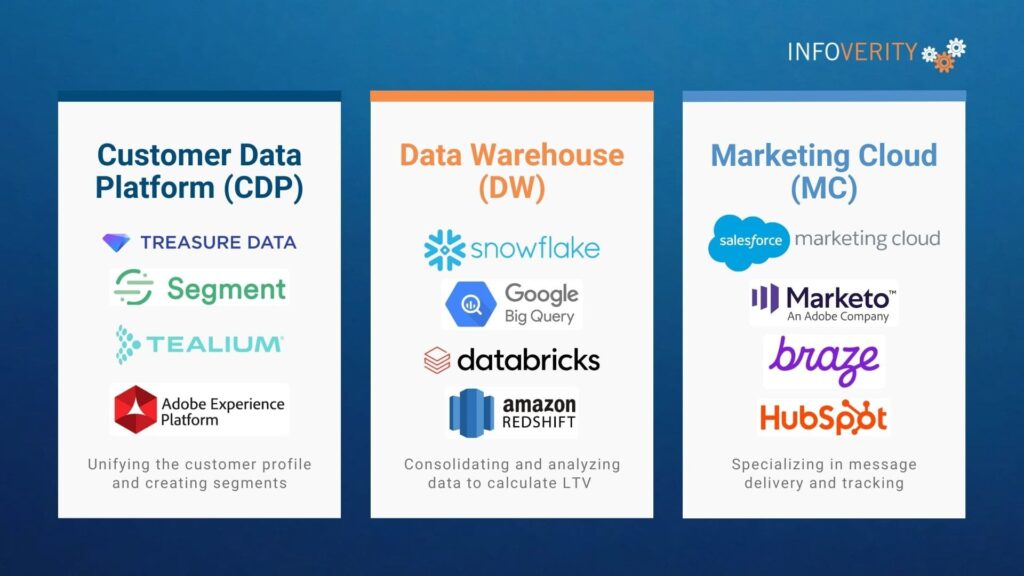
Examples: Snowflake, Google BigQuery, Databricks, Amazon Redshift
The Data Warehouse (or Data Lakehouse) is the central repository for historical data and enterprise analysis.
A Data Warehouse has a primary job of storing, consolidating, analyzing data, and providing Enterprise Governance. As such, it is the ultimate record, capable of handling massive volumes of historical data from every corner of the business, including transactional systems, ERPs, web logs, and internal databases.
Its power lies in its ability to support executive decision-making. It runs heavy SQL queries for financial modeling, calculating Customer Lifetime Value (CLV), and executing enterprise-level Business Intelligence (BI). In this context, it serves as the ultimate Source of Truth (SoT) for audit and historical comparison across the entire organization. This role is critical; a recent survey highlights that 70% of CFOs view a “Single Source of Truth” as essential for empowering executive decision-making (Kleene.ai).
However, DW’s limitation is clear: it is designed for understanding, not activation. It is typically too slow and technically complex for the split-second decisions required for real-time customer journeys across various channels.
What is the Function of the Marketing Cloud (MC)?
Examples: Salesforce marketing Cloud, Adobe Marketo, Braze, HubSpot
The Marketing Cloud is designed to act as the engine for message delivery and channel management.
A Marketing Cloud is where personalized messages and offers are created and delivered to customers and leads. It specializes in channel-specific execution, ensuring deliverability, managing suppression lists, and tracking message metrics.
What makes a Marketing Cloud powerful is its focus on execution. It manages technical delivery across critical channels like email, SMS, and push notifications, and it allows teams to create personalized messages by injecting dynamic content (e.g., first name, product details) into templates. This allows marketing teams to see near real-time tracking of message engagement.
Similarly, the Marketing Cloud has limitations. This software is designed for delivery, not identity resolution. It typically struggles to stitch together fragmented identity data (web, app, store). This often leads to “data paralysis”—recent research from Funnel reveals that 72% of in-house marketers feel overwhelmed by data they cannot turn into actionable insights because it is not unified.
It is a poor choice for building a unified, enterprise-wide customer profile required for advanced segmentation.
How Does the Customer Data Platform (CDP) Bridge the Gap?
Examples: Segment, Tealium, Treasure Data, Adobe Real-Time CDP
The Customer Data Platform is a platform that can be placed strategically between the DW/Source Systems and the MC/Activation Channels, with the primary purpose to perform Identity Resolution, Segmentation, and Real-Time Activation.
The CDP is powered by its ability to ingest data from all sources (the DW included), apply sophisticated algorithms to resolve fragmented identities, and output actionable audiences to the execution channels. It operates in real-time with large data sets to create a single unified customer profile, the “Golden Record”, by linking anonymous behavior with known identifiers (email, loyalty ID).
This foundation allows the CDP to build dynamic, actionable audiences (e.g., “High-Value customers who abandoned a cart in the last 24 hours”) that are instantly pushed to any channel, implementing real-time journey activation by routing records to Marketing Clouds, Ad Platforms, and service tools.
Similar to everything else, the CDP has limitations. It is designed for activation, not cleaning. If the source data is messy, if the governance in the DW is weak, then the CDP simply segments and activates bad data at speed.
The cost of this “garbage in, garbage out” dynamic is staggering—Gartner estimates that poor data quality costs organizations an average of $12.9 million every year.
Why Do You Need All Three? The Value of the Data Trinity
Now that we understand the unique purpose of the three platforms, we can see why there isn’t a single type of software that acts as an all-in-one solution for an organization. Each brings unique, necessary technology and capabilities for a company to succeed and compete in today’s landscape.
The maximum value is realized only when the platforms are integrated and allowed to perform their core duties without overlapping.
Platform | Primary Role | Core Function |
Data Warehouse (DW) | Strategic Insight | Consolidating and analyzing all enterprise data to calculate LTV and support financial reporting. |
Customer Data Platform (CDP) | Real-Time Activation | Unifying the customer profile and creating actionable segments instantly available across all channels. |
Marketing Cloud (MC) | Channel Execution | Specializing in message delivery, deliverability, and tracking message response. |
Businesses should not be choosing between CDP vs. Data Warehouse vs. Marketing Cloud. Instead, they must focus on developing a unified data strategy that defines the roles for the tools they already have, ensuring that the insights generated by the DW power the activation orchestrated by the CDP, which is then executed by the MC.
Where to Start: Defining Your Architecture
How do you move from chaos to this unified strategy?
Start by auditing your “System of Record.” Bring your IT and Marketing stakeholders together and map your three critical data buckets:
- Ensure your DW is the master of financial and historical data.
- Ensure your CDP is the master of the unified profile and segmentation logic.
- Ensure your MC is the master of consent and engagement.
Defining these boundaries is the foundation of truly scalable personalization.
FAQ – CDP vs. Data Warehouse vs. Marketing Cloud
What is the main difference between a CDP and a Data Warehouse?
The main difference is speed and purpose. A Data Warehouse is designed for historical analysis and strategic insight (Source of Truth), while a CDP is designed for real-time identity resolution and activation (Golden Record) to drive marketing channels.
Can a Marketing Cloud replace a CDP?
Generally, no. While Marketing Clouds excel at message delivery (email, SMS), they typically struggle with identity resolution across fragmented data sources (web, app, store) and lack the ability to build a unified enterprise-wide customer profile for advanced segmentation.
Why do I need a CDP if I have a Data Warehouse?
While a Data Warehouse stores all data, it is often too slow and technically complex for real-time marketing activation. A CDP sits on top of the data to resolve identities and push actionable segments to your marketing tools instantly.